
How to Choose the Right Industrial Gearbox
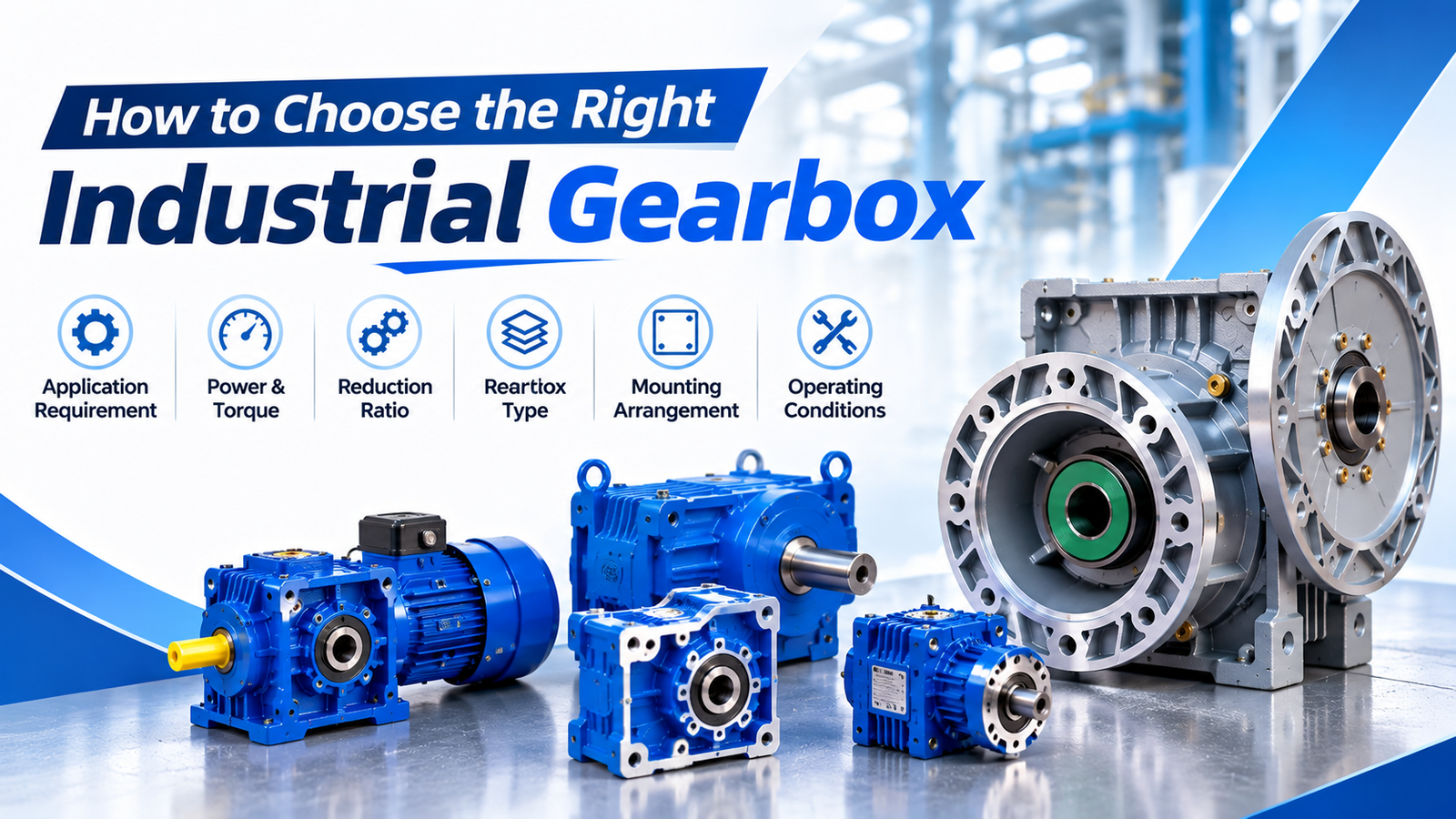
1. Introduction
Industrial gearboxes play an important role in modern manufacturing and mechanical power transmission systems. They help control machine speed, increase output torque and transfer mechanical power efficiently between different machine components.
Choosing the right industrial gearbox is essential for achieving smooth machine operation, reducing unnecessary maintenance costs and improving overall equipment performance.
However, selecting a suitable gearbox is not always straightforward. Different industrial applications require different gearbox configurations depending on motor power, output speed, torque requirements, operating conditions and installation arrangements.
Whether you are purchasing a gearbox for conveyor systems, packaging machinery, material handling equipment or manufacturing operations, understanding the important selection factors can help you make the right decision.
In this guide, Luminary Transmission Pvt. Ltd. explains how to choose the right industrial gearbox for your machinery and application requirements.
2. Understand Your Industrial Application
The first step in selecting an industrial gearbox is understanding the application in which it will be used.
Every industrial machine has different operating requirements. A conveyor system may require continuous operation at a controlled speed, while a packaging machine may need precise movement and frequent starting and stopping.
Before selecting a gearbox, consider the following questions:
What type of machinery will the gearbox operate?
What is the required operating speed?
How much torque does the application require?
Will the machine operate continuously or intermittently?
What type of load will the gearbox handle?
What are the environmental and operating conditions?
Understanding these requirements helps identify the most appropriate gearbox configuration.
3. Check the Required Gearbox Power
Motor power is one of the most important factors when selecting an industrial gearbox.
The gearbox must be capable of handling the power supplied by the connected motor under the intended operating conditions.
Power is generally measured in:
Kilowatts (kW)
Horsepower (HP)
When selecting a gearbox, consider the motor’s rated power, operating speed and application load.
Choosing an undersized gearbox may result in overheating, excessive wear and premature mechanical failure.
On the other hand, selecting an unnecessarily oversized gearbox may increase equipment costs and installation requirements.
Important Tip: Always check the gearbox manufacturer’s rated input power and permissible output torque before making a selection.
4. Determine the Required Reduction Ratio
The reduction ratio determines how much the gearbox reduces the input rotational speed.
This means the gearbox must reduce the input speed by a ratio of 20:1.
Different industrial applications require different reduction ratios depending on machine speed and torque requirements.
Selecting the correct reduction ratio helps achieve the desired machine operating speed.
5. Calculate the Required Output Torque
orque refers to the rotational force produced by a gearbox to drive connected machinery.
It is generally measured in Newton-metres (Nm).
Output torque is an important selection factor because different machines require different amounts of rotational force.
For example:
Conveyor systems require torque to move materials.
Industrial mixers require torque to rotate mixing components.
Packaging machines require controlled rotational movement.
Material handling equipment may require substantial starting torque.
Actual torque capacity must also account for service factor, operating conditions and manufacturer ratings.
6. Understand Different Types of Industrial Gearboxes
Different gearbox types are designed for different mechanical applications. Understanding their characteristics helps you choose a suitable solution.
6.1 Worm Gearbox
Worm gearboxes use a worm shaft and worm wheel to transmit power between shafts that are usually positioned at 90 degrees.
Key Features:
Compact construction.
High reduction ratios possible.
Smooth operation.
Suitable for right-angle power transmission.
Available in different mounting configurations.
Applications: Conveyor systems, packaging machinery, mixers and industrial automation.
6.2 Helical Gearbox
Helical gearboxes use angled gear teeth to transmit power between shafts.
Key Features:
High transmission efficiency.
Smooth and quiet operation.
Suitable for higher power applications.
Available in different configurations.
Applications: Manufacturing machinery, industrial conveyors and processing equipment.
6.3 Bevel Gearbox
Bevel gearboxes use conical gears to transmit rotational power between intersecting shafts.
Key Features:
Right-angle power transmission.
Compact mechanical arrangements.
Suitable for various industrial drive applications.
Applications: Material handling equipment and specialized machinery.
6.4 Planetary Gearbox
Planetary gearboxes consist of a central sun gear, planet gears and an outer ring gear.
Key Features:
High torque density.
Compact construction.
Multiple reduction ratios.
Suitable for demanding applications.
Applications: Robotics, automation, industrial machinery and heavy-duty equipment.
7. Consider the Mounting Arrangement
Mounting configuration is another important factor when choosing an industrial gearbox.
The gearbox must fit properly within the available machine space and connect securely with the motor and driven equipment.
Common mounting configurations include:
Foot-Mounted Gearbox
Installed using mounting feet.
Suitable for mounting on machine frames.
Provides a stable installation arrangement.
Flange-Mounted Gearbox
Mounted using a flange connection.
Suitable for direct machine or motor integration.
Helps simplify certain installation arrangements.
Shaft-Mounted Gearbox
Installed directly onto the driven machine shaft.
Useful for specific conveyor and industrial drive arrangements.
Before purchasing, verify the mounting dimensions, shaft diameter, flange dimensions and available installation space.
8. Evaluate Operating Conditions
The operating environment can significantly affect gearbox performance and service life.
Consider the following conditions before selecting a gearbox:
Operating Condition | What to Consider |
|---|---|
Temperature | Ambient and operating temperature |
Dust | Protection against dust and contaminants |
Moisture | Suitable sealing and protection |
Load | Continuous, intermittent or shock loading |
Operating Hours | Daily running hours and duty cycle |
Installation | Indoor or outdoor installation |
Lubrication | Suitable lubricant and maintenance intervals |
For harsh operating environments, select a gearbox with suitable protection, sealing and lubrication arrangements.
9. Check Gearbox Efficiency
Gearbox efficiency refers to how effectively mechanical input power is transferred to the output shaft.
Different gearbox designs have different efficiency characteristics.
For example, worm gearboxes generally experience more sliding friction between gear teeth compared with many helical gearbox designs.
Efficiency depends on several factors:
Gearbox design.
Reduction ratio.
Operating speed.
Lubrication quality.
Load conditions.
Manufacturing accuracy.
Selecting a gearbox with suitable efficiency can help reduce energy losses and improve overall machine performance.
Always check the manufacturer’s efficiency specifications for the required operating conditions.
10. Importance of Gearbox Lubrication and Maintenance
Regular maintenance is essential for maintaining gearbox performance and reducing unexpected equipment downtime.
Before selecting a gearbox, understand its lubrication and maintenance requirements.
Important Maintenance Practices:
Regularly inspect lubricant levels.
Use the recommended lubricant type.
Check for oil leakage around seals and joints.
Monitor operating temperature.
Inspect unusual noise and vibration.
Check shaft alignment and mounting.
Follow the manufacturer’s maintenance schedule.
Proper lubrication helps reduce friction, minimize component wear and support reliable gearbox operation.
11. Frequently Asked Questions (FAQs)
Q1. What factors should I consider when choosing an industrial gearbox?
Consider motor power, input speed, output speed, torque requirements, reduction ratio, mounting configuration, operating conditions and service factor.
Q2. Which type of gearbox is best for industrial applications?
The best gearbox depends on the application. Worm, helical, bevel and planetary gearboxes are designed for different power transmission requirements.
Q3. How do I calculate the gearbox reduction ratio?
Divide the input speed by the required output speed. For example, 1440 RPM input and 72 RPM output require a 20:1 reduction ratio.
Q4. Why is output torque important in gearbox selection?
Output torque determines the rotational force available to drive the connected machine. Selecting sufficient torque capacity helps prevent gearbox overloading.
Q5. What is the difference between a worm gearbox and a helical gearbox?
Worm gearboxes use a worm shaft and worm wheel, while helical gearboxes use angled gear teeth. They differ in efficiency, shaft arrangement, design and application suitability.
Q6. Does gearbox mounting type affect performance?
Mounting type primarily affects installation and mechanical integration. Proper mounting and alignment are important for reliable operation.
Q7. How can I improve industrial gearbox service life?
Follow recommended lubrication practices, avoid overloading, inspect operating temperature, monitor vibration and follow the manufacturer’s maintenance schedule.
Q8. Can one gearbox be used for different industrial applications?
A gearbox may be suitable for multiple applications if its power, torque, speed, mounting and operating ratings meet the requirements of each application.